
By
Stuart Kerr, Technology Correspondent, LiveAIWire
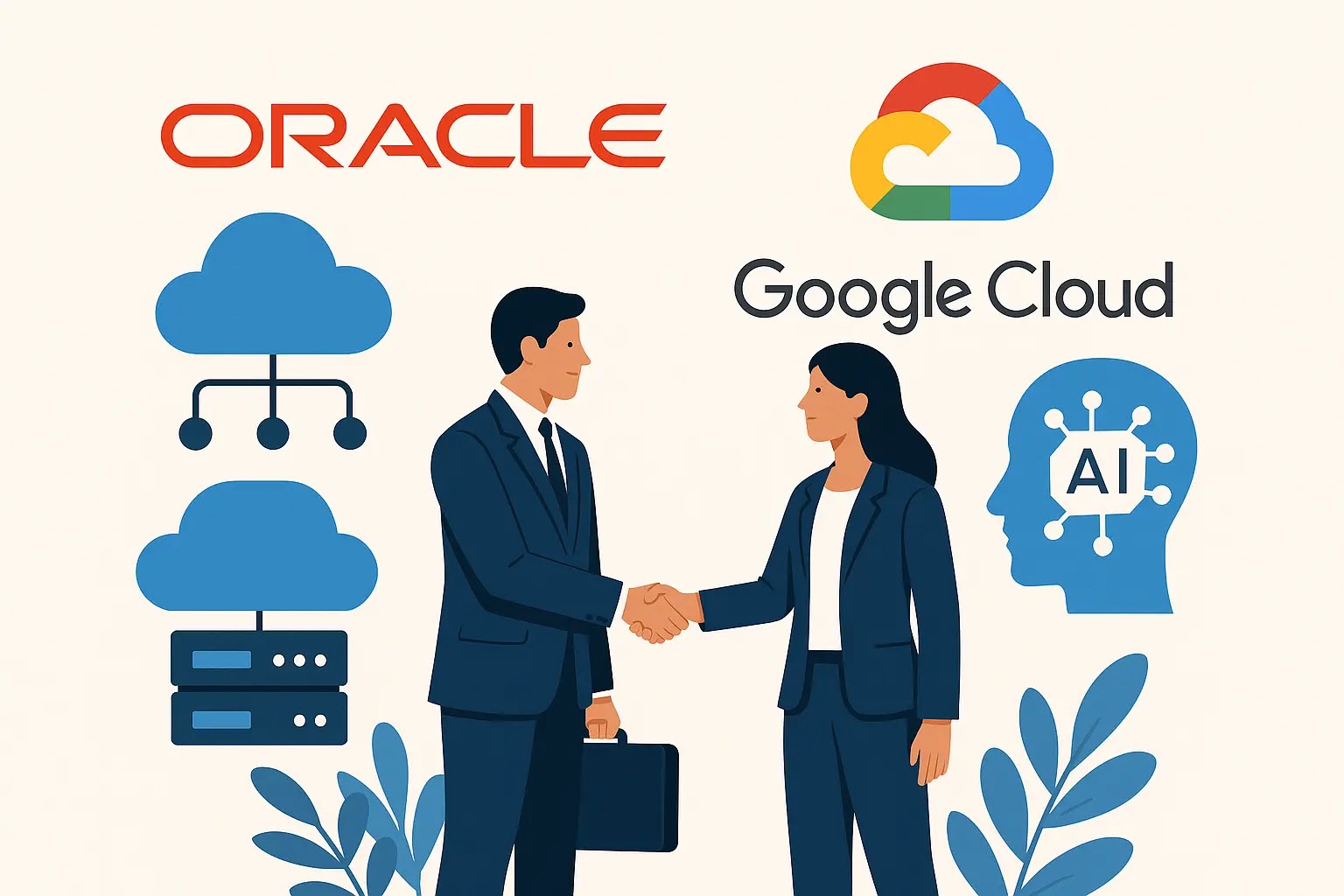
Oracle and Google Cloud have expanded their enterprise partnership
in a move that could reshape how large organisations deploy artificial
intelligence. The two companies announced on 14 August 2025 that Oracle will
distribute Google’s flagship Gemini models directly through Oracle Cloud
Infrastructure, becoming the first major cloud provider outside of Google
itself to offer Gemini as a fully managed service. The deal positions Oracle
at the heart of the next phase of enterprise AI adoption, with billing
handled through Oracle’s Universal Credits system so existing customers face
no change to their procurement process.
The agreement covers the full range of Gemini capabilities,
including multimodal understanding across text, image, video, and audio.
According to Reuters,
Gemini 2.5 is the first model available, with Google’s entire portfolio set
to follow via Vertex AI integrations. Oracle customers building AI agents for
use cases spanning advanced coding, workflow automation, and research
retrieval can now access those models without migrating workloads to a
different cloud provider.
Why This Partnership Changes the Enterprise
Landscape
The strategic importance of the deal lies in what it does to the
competitive dynamics between the three dominant cloud platforms. Microsoft
Azure already bundles OpenAI models, and Amazon Web Services has deep
Anthropic integrations. Oracle had been an outlier in generative AI
infrastructure. The Google alliance changes that picture, offering Oracle
customers access to what Google describes as industry-leading multimodal
reasoning without abandoning the enterprise stack they have spent years
building. For a company like Oracle, whose Fusion Cloud Applications serve
finance, HR, and supply chain teams at thousands of firms, embedding Gemini
into those workflows is a significant commercial opportunity.
TechRadar
notes that the deal gives Oracle a differentiated pitch to enterprises that
want best-of-breed AI without the complexity of managing multiple vendor relationships.
For Google, the partnership extends Gemini’s reach into Oracle’s vast
installed base of enterprise customers who might otherwise have defaulted to
Microsoft Copilot or Amazon Bedrock for AI services.
What Gemini Brings to Oracle’s Application Layer
The integration goes beyond raw model access. Oracle intends to
embed Gemini into its Fusion Cloud Applications, which means AI-powered
assistance will eventually appear directly in the tools HR managers use to
write job descriptions, the dashboards supply chain planners use to model
inventory, and the analytics portals finance teams rely on for forecasting.
Rather than asking employees to switch between an enterprise system and a
separate AI chat window, Oracle and Google are building Gemini into the
workflows themselves.
This mirrors a broader shift across enterprise software, where AI
is being embedded at the application layer rather than offered as a
standalone tool. In practice, a human resources manager at a firm using
Oracle Fusion might ask a Gemini-powered assistant to draft a candidate
evaluation brief, pull relevant policy documents, or summarise interview
feedback across ten candidates, all without leaving the Oracle interface. The
computational work happens on Oracle Cloud Infrastructure, with Gemini’s
reasoning capabilities doing the heavy lifting.
Security and Compliance at Enterprise Scale
One consistent concern among enterprise buyers considering
generative AI is data governance. Oracle has addressed this by ensuring that
Gemini models accessed through OCI operate within Oracle’s security
architecture. Customer data used in prompts is not shared with Google’s
broader training infrastructure, and organisations in regulated industries
such as financial services and healthcare can apply their existing Oracle
compliance controls to AI workloads. This design choice is important for
European customers operating under GDPR and for US government contractors
with strict data residency requirements.
The announcement builds on Oracle’s existing infrastructure
investments in AI. As Oracle
confirmed in its own blog post, this makes Oracle the only major
hyperscaler aside from Google Cloud Platform to offer Gemini as a managed
service, a distinction that carries real commercial weight in enterprise
procurement decisions. It also complements trends explored in the site’s
analysis of how
Google’s AI-first strategy is affecting third-party publishers
across its ecosystem.
What This Means for AI Competition in 2025
The Oracle and Google partnership is the latest indication that
enterprise AI is entering a distribution phase. The race to build the best
foundation model is not over, but the competitive advantage is increasingly
shifting to whoever can embed that model most seamlessly into the tools
businesses already use. Oracle’s enterprise penetration gives Google a route
to customers who might never directly sign up for Google Cloud. Google’s
model quality gives Oracle a credible AI story to tell at renewal
conversations with thousands of corporate accounts.
For technology buyers, the practical implication is that Gemini is
becoming harder to avoid. Whether a company chooses Oracle for ERP, SAP for
supply chain, or Salesforce for CRM, the underlying AI layer in enterprise
software is coalescing around a small number of foundation models. The Oracle
and Google deal is one more step in that consolidation, and it suggests that
the AI competition of 2026 will be fought less on model benchmarks and more
on which vendor can make intelligent automation feel invisible. The timing of
the announcement also coincides with a wave of enterprise AI deals across the
industry that reflects a strategic race to lock in distribution before
customers standardise on a single AI provider. By becoming the first
non-Google cloud to distribute Gemini, Oracle gains a negotiating chip in
renewal conversations with thousands of enterprises whose Oracle licences are
approaching renewal, which is exactly the outcome Oracle needs in an
environment where hyperscalers are competing aggressively for enterprise
cloud spend.
The long-term significance will depend on uptake. If Oracle’s
enterprise customers begin building AI agents using Gemini at scale, the deal
will be remembered as a turning point in how frontier AI reached the
corporate mainstream. Advances in emerging
model architectures are accelerating this race, giving cloud
providers a strong incentive to lock in model distribution agreements before
their competitors do. For the teams evaluating these agreements, the question
to ask is not which AI model is most impressive on benchmarks, but which integration
will require the least friction to deploy inside the tools their
organisations already depend on. That is where Oracle and Google are betting
this deal will pay off.
Beyond the immediate commercial logic, the Oracle and Google deal
signals a maturation in how enterprise software vendors think about AI. Early
in the generative AI cycle, every major vendor announced its own AI strategy,
its own foundation models, its own proprietary intelligence layer. That phase
is giving way to a more pragmatic approach in which vendors focus on
distribution, integration, and trust rather than model development. Oracle
does not need to build a model to compete in enterprise AI. It needs to be
the platform through which enterprises access the best available models
without disrupting the workflows they have invested years in building. The
Google partnership is the clearest expression yet of that strategy, and it
will likely be followed by similar agreements with other model providers as
Oracle works to ensure its cloud remains a credible alternative to the
hyperscalers that have dominated enterprise AI investment over the past two
years.
About the Author
Stuart Kerr is the Technology Correspondent for LiveAIWire. He
covers artificial intelligence, enterprise technology, and the companies
shaping the digital economy. Read
more about Stuart.