
By
Stuart Kerr, Technology Correspondent,
LiveAIWire
If you have spent ten minutes staring
at three browser tabs, one logged into ChatGPT, one into Gemini, one into
Claude, and wondering which one to actually pay for, you are not alone. In
2026, the three dominant AI assistants have converged on similar pricing,
similar general capability, and similar interface design to a degree that
makes the question harder to answer than it was two years ago. On most natural
language benchmarks the margins between the leading models are measured in
fractions of a point. The differences that actually matter for most users are
ecosystem, specialist capability, and which platform fits naturally into the
tools you already use.
This guide is built around those
practical distinctions. It covers what each platform does best, where each
falls short, how the pricing structures compare, and how to make a decision
that you will not want to revisit in six months. It is updated for the
current state of each platform as of mid-2026, with specific attention to the
task categories where the differences between the three are most relevant to
everyday users.
Table of Contents
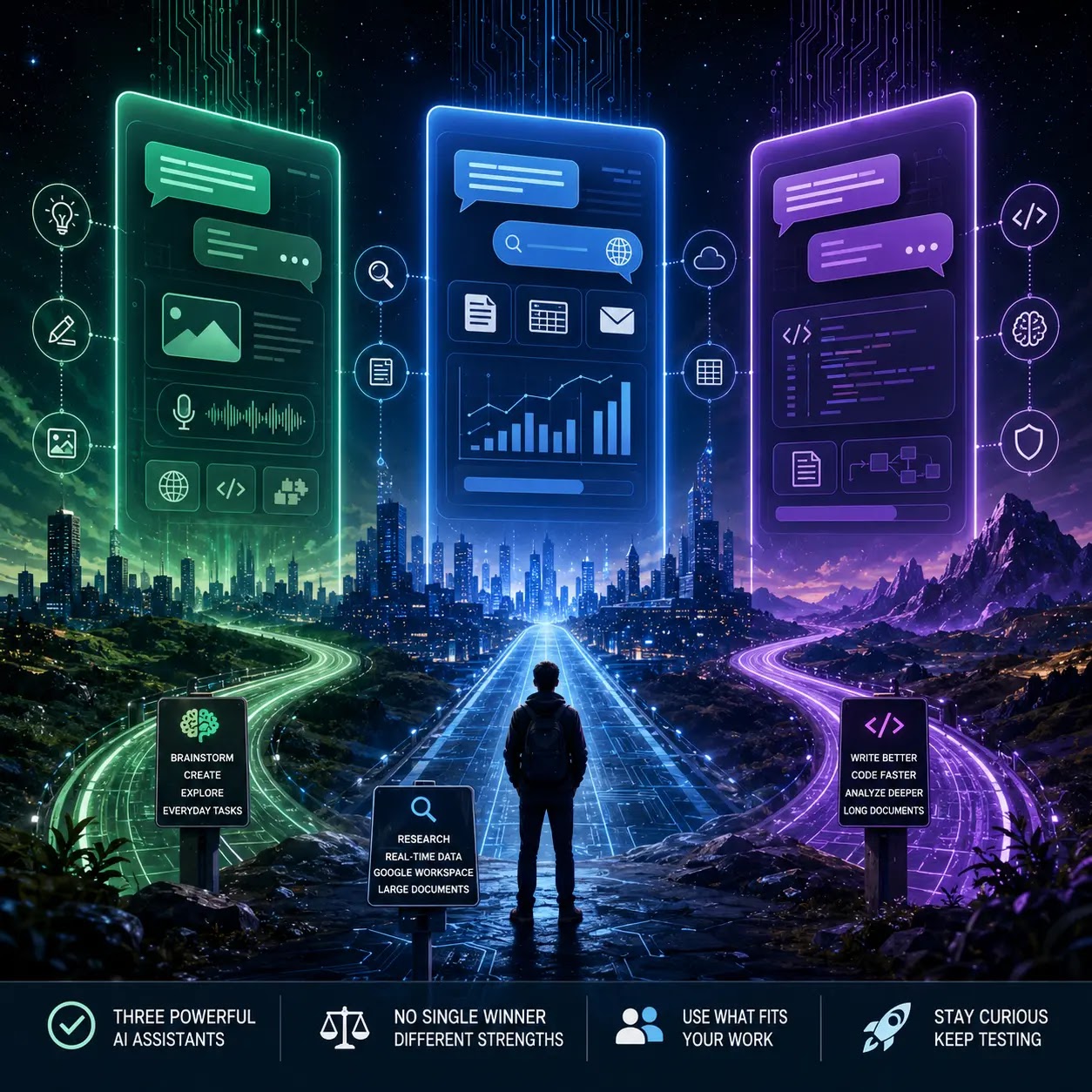
The Three Platforms in Brief
ChatGPT,
run by OpenAI,
is built on GPT-5.5 as of mid-2026 and remains the most widely used AI
assistant globally, with 900 million weekly active users. Its strength is
breadth: a mature plugin ecosystem, strong general-purpose capability across
writing, coding, and research tasks, and the best conversational memory
implementation of the three. Its relative weakness is performance on
long-context coding tasks, where it loses the thread of complex codebases
more easily than its rivals.
Claude, built
by Anthropic, runs Claude Opus 4.6 at its top tier as of mid-2026. It leads
on SWE-Bench coding benchmarks with an 80.8 percent single-attempt score,
making it the preferred choice for developers and technical writers working
with large codebases. It offers a one million token context window as
standard on Pro plans, which is the largest reliable long-context
implementation available. Its relative weakness is ecosystem depth: fewer
native integrations and a smaller plugin library than
ChatGPT.
Google Gemini 3.1 Pro
(formerly 2.5 Pro) leads on multimodal tasks, including image, video, and
audio understanding, and on throughput, with output speeds approximately
twice those of Claude. Its deepest advantage is Google ecosystem integration:
native reading of Google Docs, Sheets, Gmail, Drive, and real-time web access
through Google Search without requiring retrieval-augmented generation
workarounds. Its relative weakness is coding, where it trails Claude on most
developer-focused benchmarks.
Writing and Content
Tasks
For professional writing, all three perform well
enough that the difference is more stylistic than qualitative. Claude tends
to produce more structured, precise prose with fewer hedges and a more direct
voice. ChatGPT produces writing that is more conversational and easier to
edit for different tones. Gemini’s writing is more variable in quality but
benefits from real-time access to current information in a way that the other
two, which rely on knowledge cutoffs for factual claims, do not. For
marketing copy, social media, and short-form creative work, ChatGPT has the
widest range of style templates and the most mature memory of your
preferences across sessions. For long-form analysis and research documents,
Claude’s precision and context handling give it the edge for most use
cases.
Coding and Technical Work
Coding
is the task category with the clearest differentiation. Claude leads on
SWE-Bench Verified, the most widely cited benchmark for real-world coding
capability, and its one-million-token context window means it can hold an
entire large codebase in a single session without losing coherence across
files. For developers using integrated development environments, Claude Code
and Claude’s integrations with tools like Cursor and Windsurf have made it
the default choice for agentic coding workflows. ChatGPT with its Code
Interpreter is strong for data analysis and scripting tasks but is less
consistent on complex multi-file software projects. Gemini is capable on
basic coding tasks and benefits from its speed advantage for high-throughput
code generation, but trails on complex reasoning tasks that require holding a
large amount of context simultaneously.
For developers and
anyone whose work involves significant code, Claude is the clearest
recommendation. For data analysts who need Python scripting alongside general
productivity tasks, ChatGPT’s integrated Code Interpreter and broader
ecosystem make it competitive. Understanding how AI
agents are being integrated into professional workflows adds
context for choosing between platforms: the agent ecosystem around each is
developing at different rates, with Claude Code and OpenAI’s agentic
capabilities both advancing rapidly in 2026.
Research and
Current Information
Gemini has a structural advantage for
any task requiring current information. Its native Google Search integration
means it can access real-time data, recent news, and current prices without
the additional setup that other platforms require. ChatGPT’s web browsing
tool is capable but is not as seamlessly integrated into the conversational
flow. Claude does not include real-time web search in its standard interface,
which is a meaningful limitation for tasks where current data matters. For
research tasks with a defined knowledge cutoff, all three are comparable. For
research requiring current information, Gemini’s integration advantage is
real and practically significant.
Multimodal Tasks:
Images, Audio and Video
Gemini leads comprehensively on
multimodal understanding. Its ability to analyse video content, process
audio, and describe complex images in detail reflects Google’s investment in
multimodal AI as a core capability rather than an add-on. ChatGPT’s image
analysis using GPT-5.5 is strong for document reading and image description
but is weaker on video and audio tasks. Claude’s image capability focuses on
document analysis and chart interpretation rather than complex visual scene
understanding. For any workflow involving significant image, video, or audio
analysis, Gemini is the clear first choice.
Pricing and
What You Actually Get
All three charge approximately $20
per month for their standard Pro or Plus tiers as of mid-2026, which
simplifies the comparison. The meaningful differences are in what those tiers
include. Claude Pro includes the one million token context window at all
times. ChatGPT Plus includes web browsing, image generation, and the full
plugin library. Gemini Advanced at the same price tier includes Google
Workspace integration and real-time search. Google AI Ultra dropped to $99.99
per month for power users needing maximum capability.
For
API access, the pricing differences are more significant. Claude Haiku is
among the most cost-effective options for high-volume applications. DeepSeek
V4 at approximately $0.28 per million input tokens is roughly fifty times
cheaper than Claude Opus on input, which changes the economics of high-volume
use cases substantially. Most everyday users working through consumer
interfaces do not encounter API pricing, but developers building applications
on top of these models should factor it in carefully. The practical
guide to getting value from AI tools daily covers the non-API use
cases in more detail for users approaching this as a productivity tool rather
than a development platform.
Which Should You
Choose?
The honest answer for most people in 2026 is: one
of the three, used well, is better than two or three used inconsistently.
That said, the practical recommendations are clear enough to be
actionable.
Choose ChatGPT if you need the broadest
all-purpose capability, the most mature memory and personalisation features,
and the widest plugin ecosystem. It is the most versatile option for users
who want a single tool for varied tasks without strong technical or
specialist requirements.
Choose Claude if you write or code
professionally, work with long documents or complex technical material, or
want the most reliable performance on precision-dependent tasks. The context
window advantage is practically significant for anyone working with large
files or sustained research. Keeping an eye on how
OpenAI’s business model is evolving as it approaches public markets
is useful context for understanding why Claude has made such significant
inroads into the enterprise market that OpenAI was previously dominant
in.
Choose Gemini if you live primarily in Google
Workspace, need real-time information access, or work with significant
volumes of visual content. The Google ecosystem integration eliminates
friction that other platforms require workarounds to address, and for users
embedded in that ecosystem it is the most efficient choice by a meaningful
margin.
Many serious users in 2026 use two of the three,
routing specific task types to whichever platform handles them best. The
$20/month per platform makes that a $40 per month decision, which for
professional users who spend significant time working with AI tools is
typically justified by the performance difference on specialist tasks. The
value that going
public will place on each company suggests that all three platforms
will continue improving rapidly. The choice you make today is not permanent,
and revisiting it every six months as capabilities evolve is sensible
practice.
Privacy and Data: What Each Platform Does With
Your Input
Before committing to any AI platform with a
subscription, the privacy architecture is worth understanding. All three
handle user data differently in ways that matter for professional use. OpenAI
uses conversation data to improve its models by default, with an option to
opt out in settings. Anthropic does not use Claude Pro conversations to train
models by default. Google’s Gemini Advanced data handling is governed by its
general Google account terms, which integrate tightly with your Google
account history. For users who regularly input sensitive professional
information, business plans, client data, or confidential communications,
reviewing the specific enterprise or business tiers and their data handling
commitments is worth the time investment before the subscription begins
rather than after.
All three offer business or enterprise
tiers with stronger data isolation commitments than their consumer plans. For
individual professionals and small businesses whose work involves client
confidentiality, the consumer plans may not provide the data handling
guarantees that professional use requires. The enterprise tiers cost more but
provide contractual data commitments, which is a different category of
assurance than a consumer privacy policy.
How to Try
Before You Commit
All three platforms offer meaningful
free tiers that are adequate for evaluating the relevant capability
differences before subscribing. The most efficient evaluation approach is to
identify two or three tasks you do regularly, run the same tasks through each
platform’s free tier over a single week, and compare the outputs directly. Writing
quality differences are easiest to evaluate in your specific domain because
you can judge the output against your own professional standard. Coding
differences are straightforward if you have a real coding problem to solve.
Multimodal differences are immediately apparent if you have a document or
image to analyse. The benchmarks in this article reflect aggregate
performance across large test sets; your specific use case may deviate from
the average in either direction, which is why personal testing with tasks you
actually perform is more reliable than any published comparison for your
individual decision. The broader context of all
three companies approaching public listings suggests significant
continued investment in capability from all of them, which means the right
choice today may shift within twelve months as the competitive landscape
evolves.
About the Author
Stuart Kerr
is Technology Correspondent at LiveAIWire, covering artificial intelligence,
cybersecurity, and the social impact of emerging technology. He publishes
daily at LiveAIWire.com.