
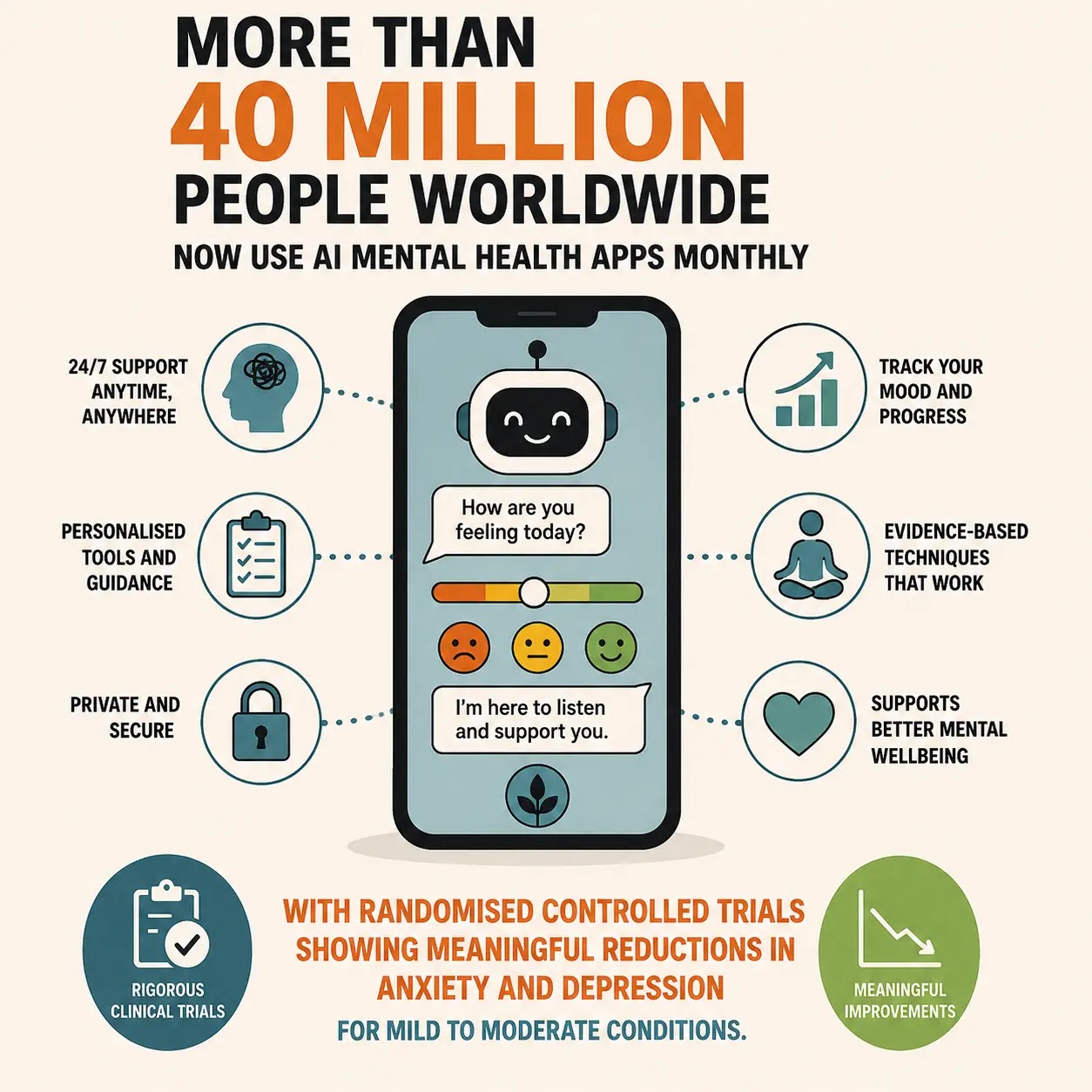
AI therapy chatbots just cleared their most rigorous clinical bar yet. A randomised controlled trial published in NEJM AI in March 2025 found that Therabot, a generative AI therapy chatbot developed at Dartmouth College, produced clinically significant reductions in symptoms among patients diagnosed with major depressive disorder, generalised anxiety disorder, and those at clinical high risk for eating disorders, according to Dartmouth’s own account of the trial. It is the most rigorous clinical trial of a generative AI mental health tool published to date, and its findings shifted the conversation from whether AI therapy can work to how, when and for whom it works best. The answers are more nuanced than either enthusiasts or sceptics have tended to acknowledge.
Mental health services globally face a structural access problem that no realistic expansion of human therapist capacity will resolve in the near term. In England, the NHS waiting list for talking therapies routinely exceeds twelve weeks. In the United States, 150 million people live in federally designated mental health professional shortage areas. AI therapy tools are not emerging because clinicians think algorithms make better therapists. They are emerging because the alternative, for much of the world, is no treatment at all. The relevant question is not whether an AI therapist matches a human therapist in head-to-head comparison. It is whether an AI tool is better than a twelve-week wait or no access at all.
For anyone considering whether to use an AI therapy tool, or wondering whether to recommend one to someone they care about, understanding what the clinical evidence actually shows, and where its limits sit, is the right starting point.
What the Randomised AI Therapy Trial Evidence Shows
The Therabot study is the landmark data point, but it sits within a growing body of evidence. A meta-analysis published in the Journal of Medical Internet Research in November 2025 synthesised 31 randomised controlled trials covering 29,637 participants, examining AI chatbot effectiveness for mental health outcomes in adolescents and young adults aged 15 to 39. The analysis found that chatbots were more effective for psychosomatic symptoms in clinical populations, those with more severe baseline symptoms, than in non-clinical groups, a finding that holds across the broader evidence base. Standalone chatbot apps were more effective for anxiety than web-integrated chatbots, suggesting that deployment format affects outcomes.
The certainty of evidence across most outcomes was rated as very low to low, reflecting the early stage of the research base rather than evidence of harm. The authors called for more rigorous study, which is the appropriate scientific response to promising but preliminary results.
The effect sizes reported in the Therabot trial were meaningful, not marginal: participants experienced clinically significant symptom reductions in depression and anxiety measures, comparable in some metrics to outcomes reported for brief human-delivered cognitive behavioural therapy. The trial compared Therabot against a waitlist control, not against active human therapy, which is the most relevant comparison for the access gap problem but not the one that answers whether AI therapy is as good as human therapy. That comparison has not yet been adequately tested at scale.
What AI Therapy Cannot Do
The limits of AI therapy tools are as important to understand as their capabilities, particularly for users who might turn to them in situations that exceed their design parameters. A study published in Psychiatric Services in August 2025 assessed popular chatbots’ ability to identify when a user was at risk of suicide, using queries of varying risk levels. The results highlighted serious inconsistencies in crisis recognition across the most widely used platforms, which is a clinical safety concern of the highest order.
AI therapy tools are not equipped to provide the level of risk assessment and crisis intervention that trained clinicians can offer. For anyone experiencing suicidal thoughts or acute mental health crises, a human clinician or crisis service is the appropriate response, and no AI tool should substitute for that pathway. As LiveAIWire’s coverage of institutions struggling to keep pace with fast-moving AI adoption has found in a different context, the pattern of technology outrunning the safeguards built around it is not unique to education. It shows up here too, in a domain where the stakes are far higher.
Beyond crisis situations, the therapeutic relationship remains an open question. Decades of psychotherapy research establish that the quality of the relationship between therapist and patient, the alliance, is one of the strongest predictors of treatment outcomes across modalities. AI tools can simulate relational warmth and provide consistent, non-judgmental responses. Whether they can build the kind of genuine therapeutic alliance that characterises effective human therapy is a research question that the current evidence base cannot yet answer. The absence of evidence on this point is not evidence of absence, but it is a reason for caution about claims that AI therapy is equivalent to human therapy for all purposes.
The Privacy and Data Questions You Should Ask
AI therapy apps collect unusually sensitive data. Conversations about depression, anxiety, relationship difficulties, trauma, and medication are among the most personal information a person can share. The privacy protections governing that data vary significantly across apps and jurisdictions, and the data is commercially valuable in ways that create incentives misaligned with therapeutic confidentiality. Before using any AI mental health tool, it is worth reading the privacy policy with attention to how conversation data is stored, whether it is used to train models, who has access to it, and whether it can be shared with third parties or disclosed to authorities in legal contexts.
For the broader picture of how AI health applications are being regulated and what data they collect, LiveAIWire’s coverage of AI health monitoring on smartphones found many of the same structural tensions playing out across the wider consumer health app market, not just AI therapy specifically.
The Honest Verdict on AI Therapy
AI therapy tools have demonstrated clinical efficacy for depression and anxiety symptoms in controlled trials. They provide access to structured mental health support for populations who would otherwise wait months or receive nothing. They are most effective for people with moderate clinical symptoms rather than either mild wellness concerns or severe acute crises. They have significant unresolved questions around therapeutic alliance, crisis safety, long-term outcomes, and data privacy. They are not a replacement for human therapists and should not be positioned as one.
For anyone navigating a mental health challenge right now, the honest advice is: an AI therapy tool is likely to be helpful if you have mild to moderate depression or anxiety, no acute crisis indicators, and no reliable access to human-delivered therapy in the near term. If you are in crisis or experiencing suicidal thoughts, please contact a crisis service directly. If human therapy is accessible to you, it remains the evidence-based first choice for most presentations. The AI tools are filling a gap, not closing one. That is a meaningful contribution, and it deserves honest acknowledgment alongside honest recognition of what they cannot yet do.
Understanding how to know when you can actually trust an AI system matters here as much as anywhere: the same calibration principle, checking evidence for a specific tool rather than assuming general AI competence, applies directly to choosing between AI therapy apps of wildly varying clinical rigour.
The regulatory environment for AI therapy tools is also evolving. The FDA’s January 2026 guidance on wellness devices clarified the oversight boundary between wellness applications and regulated medical devices, but the therapeutic chatbot category sits in a grey zone where the clinical evidence is stronger than the regulatory clarity. A tool producing clinical-grade symptom reductions, as Therabot demonstrated, arguably warrants a clearer regulatory pathway than the current framework provides. Several developers are voluntarily pursuing clinical validation rather than relying on the wellness category, which is the right direction for building the long-term credibility that genuine therapeutic tools require.
About the Author
Stuart Kerr is Technology Correspondent at LiveAIWire, covering artificial intelligence, cybersecurity, and the social impact of emerging technology. He publishes daily at LiveAIWire.com.